What Actually Happened
In early 2025, a PLA Navy task group — a cruiser, a frigate and a replenishment vessel — deployed into the Tasman Sea between Australia and New Zealand and conducted live-fire exercises, forcing commercial aircraft to divert. The group then continued around the Australian continent before heading home. It was the most visible Chinese naval operation in Australia's immediate approaches in living memory, and it was conducted entirely legally in international waters — which is precisely the point.
Australia's 2024 National Defence Strategy had already named the trend: China's military build-up is reshaping the region, and coercive tactics — including operations closer to Australia's coastline — are part of the playbook. The task group simply turned a strategy document into a photograph.
Presence Is the Message
Naval deployments like this are not about the ships. They are about normalisation. Each uneventful transit makes the next one less remarkable; each live-fire serial in international waters rehearses operations farther from home and demonstrates to every capital in the region that distance from China no longer equals safety. The target audience is not just Canberra — it is every regional government weighing how tightly to align with the United States and its allies.
For Australia, the implication is structural: the era in which geography was our primary layer of defence is ending. Long-range precision weapons, persistent cyber access, and blue-water naval presence compress the warning time every defence planner relied on. Deterrence now has to be built — in submarines, in missiles, in alliance infrastructure, and in the industrial base that sustains all three.
The Industrial Consequence
This is where the strategic shock becomes an industrial fact. The National Defence Strategy's answer — a larger, more capable, more self-reliant Australian Defence Force — requires ammunition production, missile manufacturing, naval construction, sustainment capacity, and thousands of cleared workers. Henderson, Osborne, the Guided Weapons enterprise, the AUKUS build-up: all of it exists because the threat environment stopped being theoretical.
That has a direct consequence for thousands of Australian businesses. Defence spending at this scale flows through contracts that demand DISP membership, Essential Eight ML2, cleared personnel and audited supply chains. The security requirements are not incidental to the build-up — they are part of the deterrence. An industrial base that leaks technology or stalls on compliance is a vulnerability, not a capability.
The Thought Worth Sitting With
The task group was a reminder that Australia's defence debate usually lags the threat by about five years. We discuss submarines arriving in the 2030s as if the strategic environment will wait politely. It will not. The same is true at company level: businesses that treat DISP and security compliance as something to do "when the contracts arrive" are making the same assumption — that the environment will wait. The companies that will matter in Australia's defence industrial base in 2030 are the ones becoming compliant, cleared and audit-ready now.
How Serious Defence Helps
Serious Defence exists for exactly this build-up: DISPath for DISP readiness, DISPulse for continuous Essential Eight ML2 compliance, and DISPeer for sovereign cloud that keeps controlled data onshore. Our AUKUS compliance guide maps the full obligation stack — and our Henderson precinct coverage tracks where the industrial build-out is heading next.
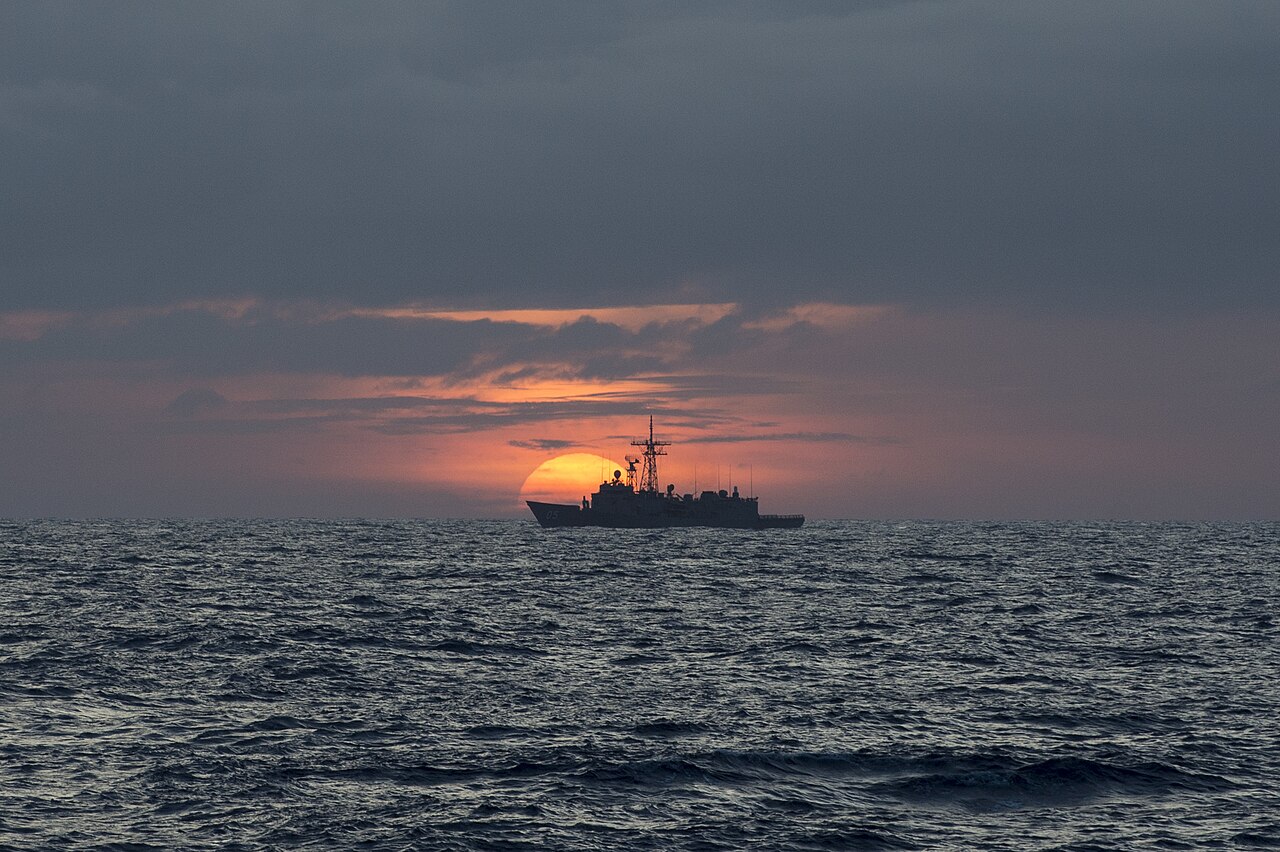
Image: HMAS Melbourne underway at sunset, RIMPAC 2018 (public domain, US Coast Guard photo).