Everyone Is Building the Wrong Model
Public discussion of AUKUS delivery risk focuses on hardware: can Osborne build the boats, can Henderson sustain them, will the US transfer Virginia-class submarines on schedule. These are real questions. But talk to the companies actually mobilising for AUKUS work and a different constraint surfaces first: people with clearances, working for companies with DISP membership, inside facilities that meet the standard. The Henderson Defence Precinct alone is projected to support around 10,000 jobs over two decades — in one of the tightest labour markets in the country.
Clearance Time Cannot Be Compressed
AGSVA publishes target processing times: roughly 20 business days for Baseline, 70 for NV1, 100 for NV2, and 180 for Positive Vetting — and those are targets, not guarantees, in a system whose vetting delivery has been scrutinised by the ANAO. A company that wins a contract in March and then initiates clearances has a workforce in the second half of the year at best. A company that initiated clearances a year earlier starts work immediately. That is the entire game.
And clearances attach to people, but work attaches to companies: the cleared person must sit inside a DISP-member organisation, under a Security Plan, with a Chief Security Officer and Security Officer of their own — who also need clearances. The dependency chain is long, and every link is measured in months.
The Second Bottleneck: Compliance Capacity
Even where people are available, DISP membership is not instantaneous. Defence publicly acknowledges a significant application backlog and prioritises processing for entities with current contracts, live tenders and supply-chain roles. New applicants are learning the hard way that "we will get DISP when we win work" inverts the actual sequence: DISP is increasingly the condition that lets you compete for the work in the first place.
The companies moving fastest share a pattern. They nominated their CSO and SO early. They initiated clearances before they were needed. They treated the Essential Eight ML2 uplift as an engineering project with a deadline, not an IT wish list. And they built their compliance evidence as they went, so the application was assembly, not archaeology.
Why This Is Actually Good News for Prepared SMEs
A constraint this binding creates an unusual market: being ready is itself a competitive advantage. Primes cannot deliver AUKUS work without compliant subcontractors, and they cannot wait a year for a supplier to become compliant. An SME with DISP membership, cleared key personnel and a working ML2 environment is, right now, a scarce asset — and scarcity is pricing power.
The uncomfortable mirror image: every month of delay compounds. Clearances initiated today land in months; DISP applications lodged today join a queue. The workforce bottleneck punishes hesitation far more than imperfect preparation.
What Serious Defence Recommends
Sequence it properly. First, nominate your CSO and SO and initiate their clearances — the longest pole. Second, run a DISP gap assessment to size the work honestly. Third, treat E8 ML2 as a project with an owner and a date. Fourth, lodge the application with complete documentation — incomplete applications are the leading cause of delay. DISPath runs this as a structured program with fixed scope, and DISPulse keeps the resulting evidence base current for your Annual Security Report. Our Henderson workforce analysis covers the WA picture, and the cost guide sets out what to budget. The bottleneck is real — which is exactly why clearing it early pays.
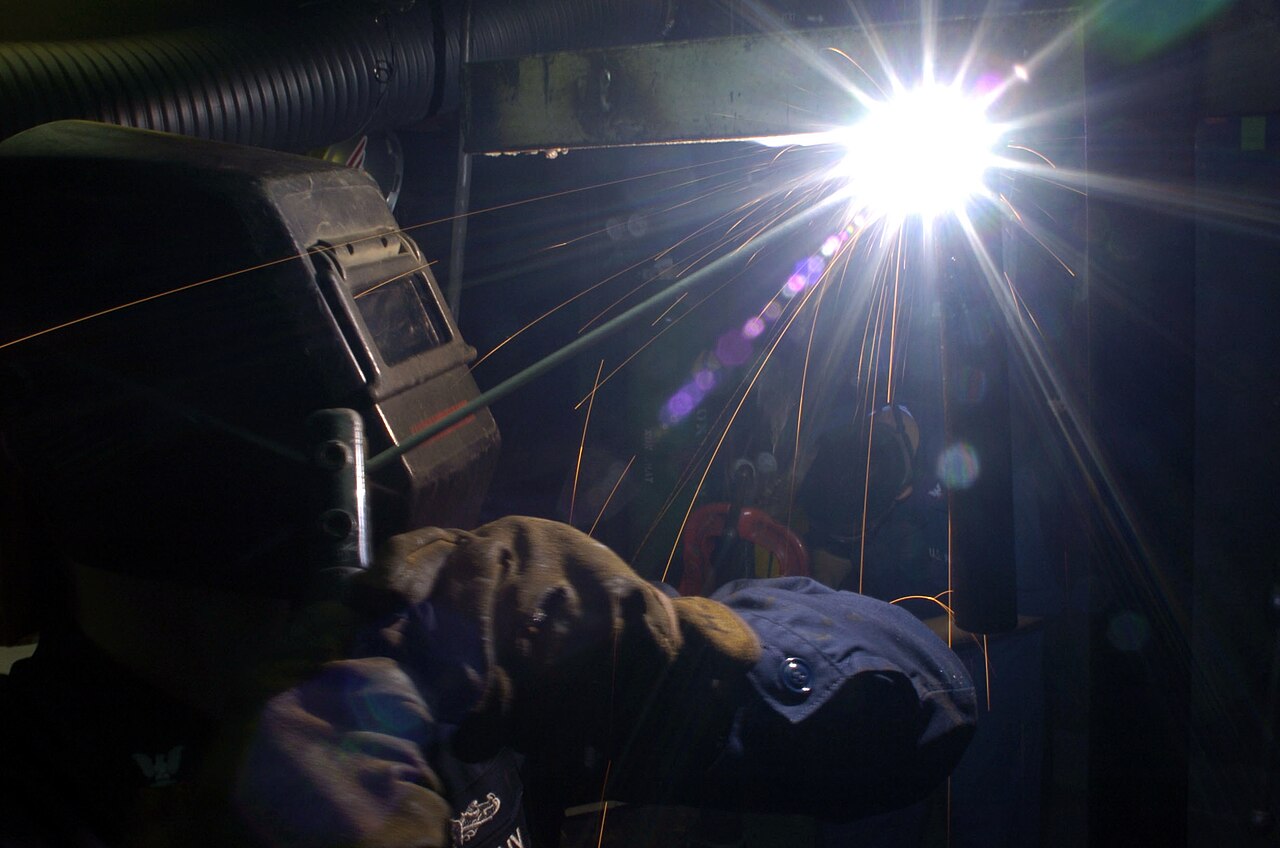
Image: US Navy hull technician welding (public domain, US Navy photo).